
What is SEO and how can I use it right now?
There was a time before search engines, and if you are too young to remember it, let me tell you, when they were first introduced to the general public there was only one thing in everybody’s mind: How do we make money with this?
They quickly figured out that clicks meant coins, so the higher you were in the search results, the better. This started a whole new bunch of strategies to get to the top search spots and Voila!
That’s how SEO was born.
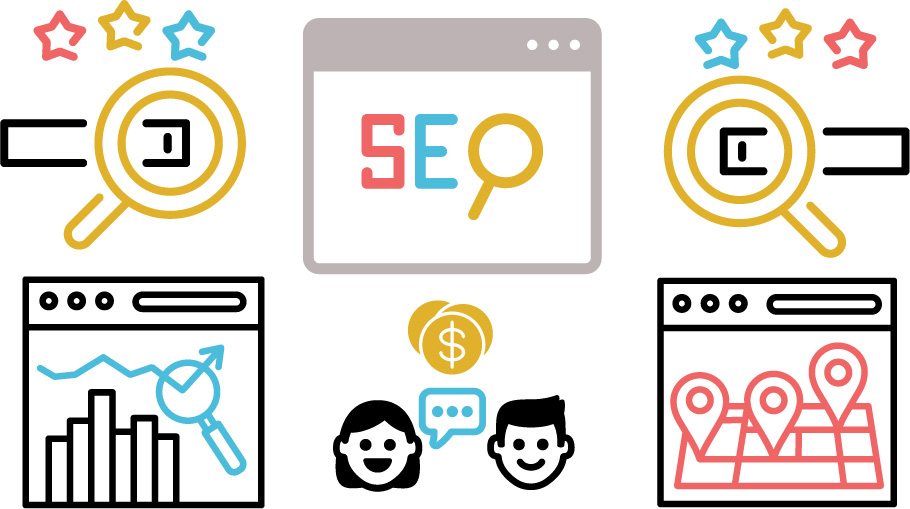
SEO (not to get it confused with CEO) means Search Engine Optimization and it is the process of improving the quality and quantity of a website from a search engine.
It is maybe the discipline that has changed the most with the years. Panda and Penguin’s versions are very different to Hummingbird’s and with the cookies’ legalities it might keep changing in the future. Nevertheless SEO is about making the user’s life easier, even going as far as calling it Search EXPERIENCE Optimization.
Even though there is a long list of things that determine the position of a webpage in a search engine, it basically boils down to two things: authority and relevance.
Authority: The ringleader, the most popular page, the one at the top of the search. The search engine infers that this page has the most valuable information based on the user experience. The more users share it, then the more users find it useful.
Relevance: How similar is your search to this result. It’s not the same to look up for “restaurants” than to look up for “Italian restaurants near me”. In the past, there was a way to “cheat” the search engine and get relevant by writing key words a bunch of times, but not anymore. (Sorry!)
Then, SEO has another subdivision: on-site and off-site.
On-site: The work INSIDE the site. This one is the optimization of the web, so the search engine understands the content in it. It focuses on relevance. It is important that your site has its keywords perfectly worded, a clean code, a decent loading time and a friendly text formatting.
Off-site: The work OUTSIDE the site. Everything that orbits your webpage, like the quality and quantity of your links, social media presence, media mentions, brand authority and performance in search results. All of this helps your overall click-through rate (CTR) and on-site performance.
Once you decide you want to use SEO, you have to make another decision: play by the rules and use White Hat SEO or be naughty and use Black Hat SEO.
White Hat SEO: Every practice the search engine encourages and recommends. All the ethically correct actions that make your web organically find its place in the top. You have to be aware of your web and why people use it. Find a good fix based on knowing your clients and what they want from you.
Black Hat SEO: The opposite. Trying to cheat the search engine by Cloaking, Spinning, SPAM, Keyword Stuffing and many other creative ways that don’t have a name yet. I’m not saying it isn’t recommended because it’s wrong, i’m saying it’s not recommended because it is a short term strategy, you won’t have any long term benefit and you might endanger your brand and website.
Why is SEO Important?
About 93% of internet dwellers use search engines. If you want to have an internet presence for your brand, it is important that the user can find you.
SEO makes life easier for everyone involved, because it helps search engines to understand what your site is about and if it is helpful for the users. If it is, then the search engines are more likely to recommend it.
Difference between SEO and SEM
We have to talk about this issue because it might cause a lot of confusion when we are dipping our feet into the waters of Digital Marketing. Even though they sound mighty alike, there is a big difference between them: money.
As we said before, SEO means “Search Engine Optimization” while SEM means “Search Engine Marketing”
SEO is the organic positioning of a website. We talked about it before, it’s all the things you can do to make it to the top without having to pay the search engine. In other words, organic = free.
SEM refers to all those strategies that include the use of paid ads. You create an advertising campaign and, by hiring the services of the search engine, your paid ad shows up on top of the organic search of the user (as long as it matches their search intent).
Which one to choose?
If you want a good digital marketing strategy, my recommendation is to use both.
You can use SEM to get results in the short term (instead of black hat SEO) to increase visibility or brand recognition quickly (extremely recommended when your brand is new) or when you want to launch products or promotions for a limited time (think Christmas or Mother day’s) .
And SEO to get results in the long term. It might be tedious, but you have to work in bringing better quality visits constantly.
The digital experience became one of the legs in which every brand stands.
Having long and short term strategies working hand in hand help you create an immersive digital experience for the user.
How to put together a good SEO strategy
1. Define your goals
What do you want to achieve with this SEO strategy? You have a number of choices to pick from. The most common are:
- Increase organic traffic
- Generate more sales
- Increase brand authority
It is highly recommended that your SEO strategy aligns with your overall marketing strategy and your brand values. If your most urgent need is to generate more sales, then you need a more aggressive strategy than if you want a long term education of the market.
2. Create a buyer persona

A buyer persona is the ideal representation of your client. Of course, it’s fictional. You create it in order to visualize how a possible customer will interact with your brand.
It is different from a target audience. The buyer persona has a specific and detailed description and made up life. What they like, what they are interested in, which ones are their problems and which ones are their motivations.
This allows a better understanding of what a customer might expect while interacting with our SEO. How they search, where do they search, how they write, at what time and what sort of content they expect from us.
That is, it will give a north to your digital strategy and will allow you to write for real people and search engines at the same time
Of course everything your brand sells must be made for this buyer persona.
3. Install basic SEO tools
To start your SEO strategy, you’ll need, at least, some basic analytic tools to monitor your impact in each step.
Chances are you are going to focus on Google. There are only a few large markets where Google is not the leading search engine, and in most cases, when it is not the leading in a given market, it is lagging behind a local player. The most notable example markets are China, Japan, South Korea, Russia and the Czech Republic where respectively Baidu, Yahoo! Japan, Naver, Yandex and Seznam are market leaders.
Anyway, two indispensable tools for SEO: Google Analytics and Google Search Console.
Google Analytics
Google Analytics is used to track website activity such as session duration (how much time a person spends on your website), pages per session (the average number of pages a person views in a given session), bounce rate (where people tend to leave your page), etc. of individuals using the site, along with the information on the source of the traffic.
Of course you can (and is recommended) use it along with Google Ads, with which you can create and review online campaigns.
You can also identify how your pages are performing with techniques such as funnel visualization (shows the stream of visitors who follow specific paths of a website and thus interact with it in order to reach a website goal), referrers (where pvisitors came from), geographical position (where are your visitors from) and how long have they stayed in your page.
There is also custom visitor segmentation, which provides even more information.
The tool also provides e-commerce reporting which allows you to track sales activity and performance: revenue, transaction, average order value and many others.
You can even use the Real-Time analytics, which enables the user to have insight about visitors currently on the site.
Google Search Console
Google Search Console is a tool that helps webmasters interact with Google. It is a much more technical tool but it has a very friendly interface and it provides valuable information for SEO, such as: List internal and external pages that link to the website, get a list of links which Googlebot had difficulty in crawling, highlight to Google Search elements of structured data which are used to enrich search hit entries, view site speed reports from the Chrome User Experience Report.
The tool can also generate various ideas for content optimization, as well as being the main source for identifying queries that drive traffic to your pages and the click-through rate of your main keywords.
Ubersuggest
Ubersuggest is a free keyword matching tool. It suggests multiple different combinations of words depending on which one you input on the search bar.
This allows you to reach many more potential clients who might be hidden behind different synonyms (or typos) you never considered.
Speaking of keywords…
4. Do keyword research
We are almost there. We know who are we talking to and what do they want. We know how we are going to check their movements, now we have to figure WHAT are we going to say to them.
Keywords are called that because they are key to your buyers. It is a word (or a bunch of) that your clients use to find out what they are looking for in the search engine.
It might look simple but it has certain magic behind it. For example, let’s say you are Brazilian and want to travel to the US. If you search “brazil traveler to usa need a visa.” The word “to” and its relationship to the other words are very important to understanding the meaning. It’s about a Brazilian traveling to the U.S., and not the other way around.
Also, it’s not the same to look up for “best destinations in Brazil” than “cheapest destinations in Brazil”
Those keywords are defined by the interests of your buyer persona and you better know that client very well because if you try to use too many keywords you might end up with empty hands.
You need to do a good word research before:
- Use tools like: SEMRush or Ubersuggest to identify which are the “buzzwords” you need to use.
- Look up how relevant is the search volume for said words.
- Make a list with the top keywords and make sure to highlight them.
Besides all this, it is very important that you know the location of your audience, since this information will guide all the content production of your website.
Many people have tried to use the same campaign for all the spanish-speaking countries but this can lead to a sure disaster since words, meaning and intentions are not the same in each country.
5. Analyze the competition to identify opportunities
I’m not saying that you should copy your competition, but you want to keep an eye on what they are doing.
You can use tools like SEMRush to check out what keywords are they using (Or if they are using some sort of black hat SEO) which ones are their most sold items and, if you feel like playing detective for a bit, try to figure out what they think their buyer persona is.
You can use this information to further your practices and create better content (than them).
6. Organize the contents with the Topic Clusters methodology
Once you create your articles using your keywords and talking to your buyer persona, you’ll need just one more thing: Topic Clusters.
Years ago we needed to be very specific with our search engines to make them understand what we wanted, nowadays, thanks to technology evolution wecan be more “casual” with our computers. We talk more naturally to our searches.
Even though we talked a lot about keywords, the thing is, they don’t do much by themselves. They are essential elements for the proper development of content and for positioning, but you will not get good positions if you make content thinking only about them.
That is why it is necessary to offer a context, and that is the proposal of the Topic Clusters.
Through the contextualization of mainly related topics, the idea is to show the search engine that you have the best possible offer for the user in a comprehensive way.
Try SEO today
SEO is a very complex but rewarding tool.
Imagine you have a restaurant, SEO is your creative and beautifully written blackboard with your menu on it. You have to keep It nice, clean and updated,so it can be one of your best selling tools.
People will look at it, or notice the little “specials” written on top of it, and soon they’ll probably be your regulars.
Same thing with your SEO, prepare an alluring blackboard and start reaping clients!