Adventure games: Shaping video games, the internet and you
Remember those idyllic times before the internet?
You had to check the tv guide to know about a show, the telephone guide to get an acquaintance’s number, and you had to pray to the lords for your local video game magazine to have some sort of hint for that point-and-click game you started six months ago.
If you played video games during the 80’s you probably played a Roberta Williams (Sierra On-line) game like Mystery House or Phantasmagoria. And if you played during the 90’s then probably a Ron Gilbert game (LucasArt) like Monkey Island and Grim Fandango.
This adventure game parents shaped (and created) a whole genre of video games that forced you to scratch your head and think outside the box every time you were faced with a puzzle.
Grab your synthesizer, we are going to the 80’s:
When graphics were rudimentary or even nonexistent, game developers had to rely heavily on text and commands.
Remember those first adventure games like Colossal Cave Adventure (1976)? In the game, the player controls a character through simple text commands to explore a cave rumored to be filled with wealth. Players earn predetermined points for acquiring treasure and escaping the cave alive, with the goal to earn the maximum number of points offered.
Colossal Cave Adventure was the first known work of interactive fiction and, as the first text adventure game, it is considered the precursor for the adventure game genre.
Four years later,Roberta Williams came up with Mystery House (1980), a game you might remember from the movie Big (1988).
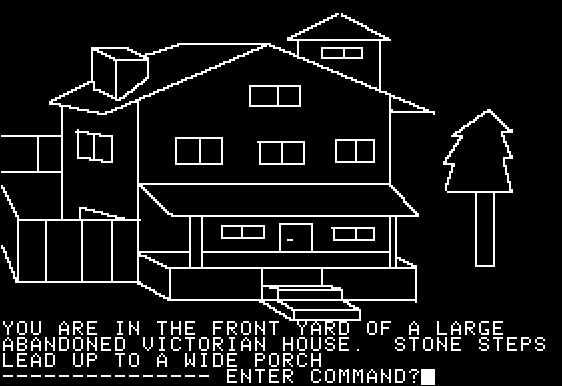
The game starts near an abandoned Victorian mansion and the player is soon locked inside the house with no other option than to explore. The mansion contains many interesting rooms and seven other people: Tom, a plumber; Sam, a mechanic; Sally, a seamstress; Dr. Green, a surgeon; Joe, a grave-digger; Bill, a butcher; and Daisy, a cook.
Initially, the player has to search the house in order to find a hidden cache of jewels. However, dead bodies (of the other people) begin appearing. It becomes obvious that there is a murderer on the loose in the house, and the player must discover who it is or become the next victim.
Sure, there have been games based on command text, but this one had graphics. Williams even drew the 70 pictures herself. Then came “The Wizard and the Princess” which added color to the mix and, in the Commodore 64 version, you could see your inventory items in detail, like a magic coin or a heart locket.
This story would inspire the later King’s Quest (1984), an adventure game that sold 400000 copies in the 80’s! (remember: not everyone had computers and videogames were seen as an arcade-thing only)
Another videogame about a Mansion
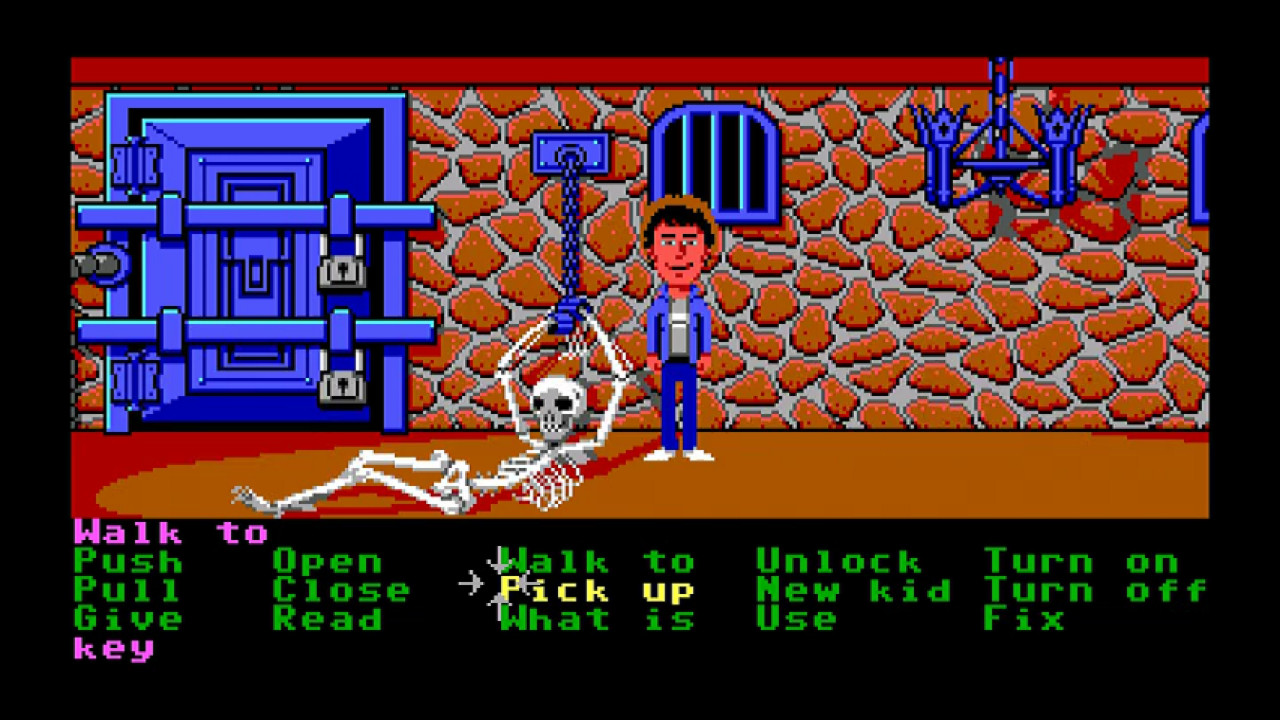
We talked about the mom, now let’s focus on the adventure game’s dad: Ron Gilbert. He and Gary Winnick also conceived a video game about a creepy Victorian manor, in 1985. It was called Maniac Mansion and takes place in the mansion of the fictional Edison family: Dr. Fred, a mad scientist; Nurse Edna, his wife; and their son Weird Ed.
Living with the Edisons are two large, disembodied tentacles, one purple and the other green. The intro sequence shows that a sentient meteor crashed near the mansion twenty years earlier; it brainwashed the Edisons and directed Dr. Fred to obtain human brains for use in experiments.
The game begins as Dave Miller prepares to enter the mansion to rescue his girlfriend, Sandy Pantz, who had been kidnapped by Dr. Fred
If you ever played one of Gilbert’s games you know what kind of humor he enjoys. The whole idea is based on making fun of silly horror films and B-movies types of clichés. You can also notice how much he hated command lines (he makes fun of those in Monkey Island, but we will talk about that later), so he came up with a simple point and click interface.
The player starts the game by choosing two out of six characters to accompany protagonist Dave Miller: Bernard, Jeff, Michael, Razor, Syd, and Wendy. Each character possesses unique abilities: for example, Syd and Razor can play musical instruments, while Bernard can repair appliances.
The game may be completed with any combination of characters; but, since many puzzles are solvable only by certain characters, different paths must be taken based on the group’s composition. Gilbert also coined the word “cutscenes” for those scenes that interrupt the gameplay to advance in the story and inform the player about events that are offscreen.
So, what are we getting here? Multiple game endings, so the player could replay and get a different adventure each time, a must have in video games nowadays.
- Different character abilities, a staple in RPGs games.
- Cutscenes. Love them or hate them, it’s hard to imagine a video game without those. (Same reason than in movies, the player has to know stuff the character doesn’t know yet)
- And last but not least: Point-and-click. The technology that potty trained us for mouse usage.
You can’t get a more forward name. It is exactly that: you point your cursor and click the left button hoping to get a reaction from your character or their surroundings.
Mom and dad taught me how to use the spoon
Of course it is easier now with our modern mice (or is it mouses?) but you have to remember that computers were really keybord heavy until the mid 90’s and the awful round ball of the Commodore wasn’t very user friendly.
If you were like most people, you got pc video games before an internet connection on your computer (If you are younger, pretend that you know what we are talking about). So there is a big chance you learnt how to move around your computer thanks to an adventure game.
And there is an even bigger chance that the first thing you looked up on the internet (besides a raunchy picture of a certain celeb) was how to solve a difficult puzzle in an adventure game title.

The Internet wasn’t the neat sleek city we see today. And we, web cosmopolitas, often forget the jungle of uncertainty we had to face back in the before times. Like pilgrims, we arrived at a new land with no rules and no directions. There was no Google to answer with a walkthrough within seconds. No. We had to face the unknown and search inside forums.
Kids nowadays have it so easy, with their tok-tiks and their verified sites
Maybe that’s why we actually tried every little item in every little crook and cranny. Because we didn’t have a fast (and safe) answer and because the puzzles had to have some sort of logic… right?
Except most of the time there wasn’t a logical answer. No, most of the time you had the feeling Roberta and Ron were drunk out of their asses and throwing darts at a target with the most stupid answers tapped on it.
And i’m not talking about some confusing lost-in-translation jokes (Like a literal red herring) Some adventure games were so difficult Sierra On-line even came up with a phone line to get hints. (This was also mocked in a Monkey Island game) Don’t get me wrong, getting stuck IS half the fun of an adventure game. If a playthrough is too easy you get the feeling that you are too good for it (or that you shouldn’t have spent $50 in it)
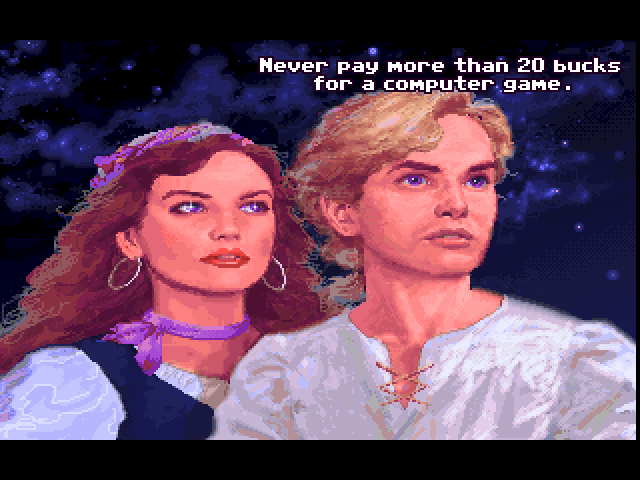
Make them hard but not too hard
Ron Gilbert himself spent years learning from his environment and the adventure game species and came up with a long list of tips for a quality video game. In summary, these are:
- Make the end objective and sub-goals clear at all times. Don’t let your player wander around wondering what they need to do next.
- No puzzles that require the player to die to get to know what to do next.
- No “Backwards Puzzles”: never find the solution before you face the problem.
- Do not require players to pick up items that are used later if they cannot go back.
- Puzzles should emerge from the story; they should be part of the story and not slow down the game for no reason.
- Don’t use real time in time-based puzzles but allow for some clearance.
- Reward players (by revealing new areas, new plot elements, twists, …) for proceeding in the game.
- Design puzzles that make sense.
- Reward the intent of the players - don’t design interfaces that punish the players even if they already got the right idea.
- Don’t have unconnected events that allow for access to new areas.
- Allow for options and exploration in the world, don’t lock the players up in restricted areas.
I would also add: Don’t make the player pixel hunt.
It is madness. I’ve technically finished a game 15 years later because I couldn’t find a little tiny pixel hidden under a fridge.
You said difficulty was part of the fun! What gives?
Well, a lot of people started pointing fingers when the once reigning adventure games genre started to decline.
Some blamed the new and popular FPS games like Doom, which felt fresh (and cost a fraction of the money to make). Then Myst came along, got people demanding CD-fulls of graphic images, and that fraction became even smaller, so you could spend X on an FPS and sell a million units easily, or 5 or 10 Xs on an adventure game and sell 100,000 units.
Others, that you can’t ramp up difficulty in adventure games as easily as virtually every other type of game. Most games you can speed things up, or cause more damage, or level up to progress in difficulty and give the player better tools to confront challenges… but puzzles are very hard to scale this way.
For example?
Let’s talk about Monkey Island once again and it’s most despised puzzle: The monkey wrench one.
The Problem:
On Phatt Island, our protagonist Guybrush reaches the top of a waterfall where there is a pump. Presumably, Guybrush needs to turn it off to stop the waterfall, so he can cross to the other side. However the pump doesn’t turn. Further interaction offers no clues. There is seemingly nothing else in the area that would help, nor does my inventory contain any relevant items.
The Solution:
Guybrush must go to the Bloody Lip bar on Scabb Island where he will find Jojo the monkey playing the piano. There is a metronome ticking. He must place the banana from his inventory onto the metronome in order to mesmerise Jojo and ‘freeze’ him in his current position. Jojo can then be picked up and added to the inventory.
Guybrush can now go back to the waterfall and use the monkey to turn the pump.
Get it? it’s a MONKEY wrench!. Hilarious.
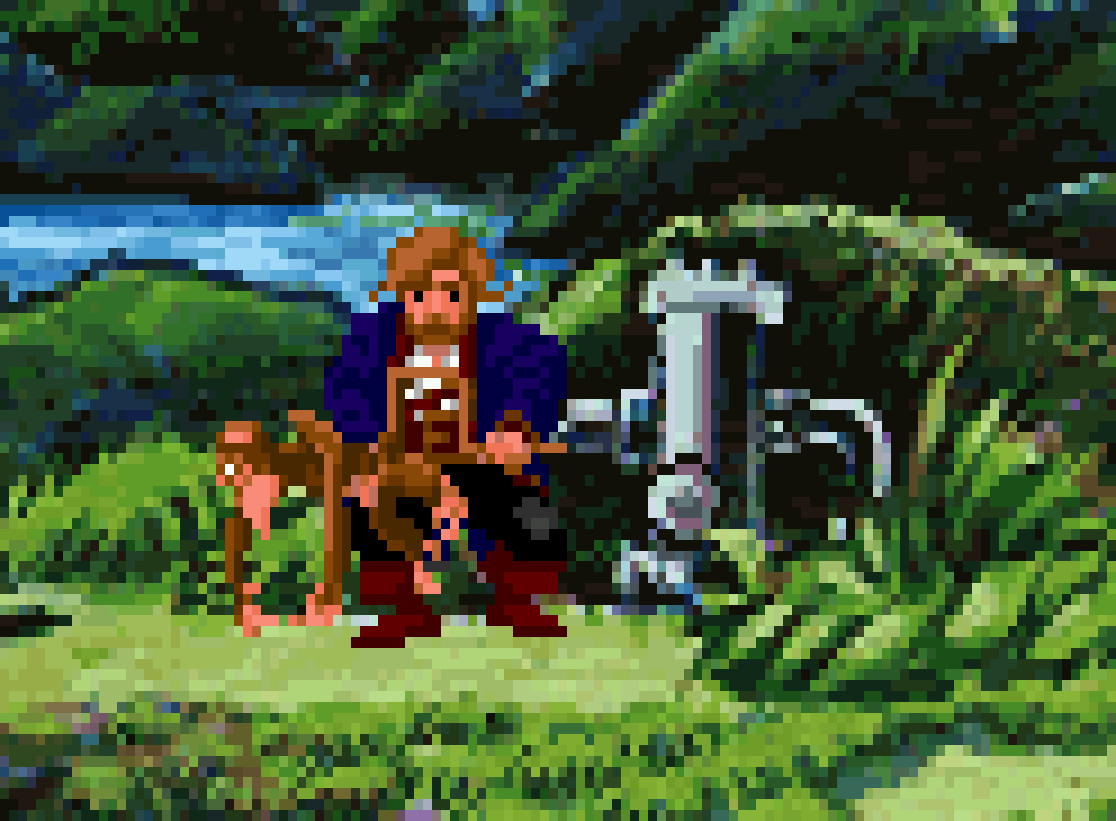
My bet is that many players got this answer by trial and error, by mistake, or by waiting some years and asking the internet. Sure the game has a certain comedic tone which fits the joke, but the thing is, If you are faced with a pump in an adventure game, you’ll probably search everywhere for a tool. I don’t know how many people thought “I need a monkey wrench, oh wait! there is a monkey at the bar.. etc”.
I’m not very sure how many people even know what a monkey wrench is, as it is a very American term. (And no, this is not me being salty because the puzzle made no sense when I was little and played a translation)
It seems like most people remember old puzzles and get frustrated once again with Sierra and LucasArt and get thrown off from adventure games.
Let’s go on an adventure!
But there is also the other side of the coin, people who remember them fondly and lovingly. How can you not? Think of any new game you have played. Even if it’s a rogue like, an RPG or an action game. Almost all of them have some sort of puzzle to solve.
Think of the broad term that is “adventure”. According to the Merriam-Webster dictionary, it means: “an exciting or remarkable experience”. That could be anything! All games are adventure games, even when they don’t want to.
They take you to a journey of mysteries, puzzles and quests and immerse you in such rich narratives and worlds that you find yourself unable to contain your joy when faced with a new adventure.
You are making it possible
After a dark decade, adventure games seem to be getting back on their feet. What seemed like silly wide-eyed optimism is today a reality.
I think indie games were the ones that kept the flame alive after all these years. When a lot of publishers shyed from slow paced games and puzzle riddled games, they were the ones giving us masterpieces like: The Last Door (2013), The Room (2012) or Return of the Obra Dinn (2018)
There is also the revival of the Point-and-click games with Thimbleweed Park (2017), Sam & Max (2021) and the remasterization of the Monkey Island Saga. And we also got triple-A successes like LA Noire (2011) and the Walking Dead (2012) and The Wolf Among Us (2013)
Hero’s Journey
In narratology and comparative mythology, the hero’s journey, or the monomyth, is the common template of stories that involve a hero who goes on an adventure, is victorious in a decisive crisis, and comes home changed or transformed.
Adventure games are the hero and the journey at the same time.
They gave us a journey in which we learnt things about our world and about ourselves and let us come back transformed. We trained the terrible beast known as “computer”, we traveled the mysterious lands of the internet and we learned that no matter how impossible something looks, there has to be a way of fixing it. Even if it means thinking (way) outside the box